|
 |
 |
 |
 |
 |
 |
|

|
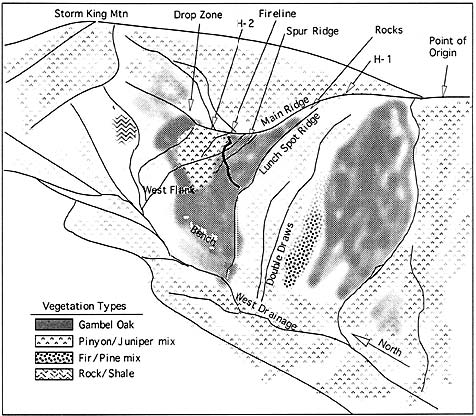
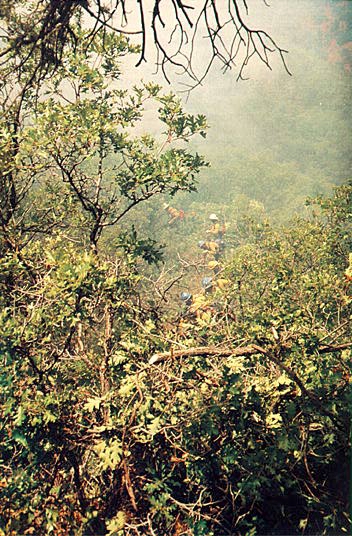
Fire EnvironmentFuelsVegetation in the area consisted primarily of Gambel oak (Quercus gambelii) on the north- and west-facing slopes and open, mixed pinyon-juniper (Pinus edulis and Juniperus sp.) with a cured grass understory on the south-, southwest-, and east-facing slopes. A few “pockets” of Douglas-fir (Pseudotsuga menziesii) existed in the area of the Double Draws, the Bowl, and on the lower east-facing slope of the West Drainage. Continuous cured grasses and some shrubs and small stands of pinyon-juniper covered the bottom of the north-south oriented West Drainage (Anon 1994). The Bowl contained a heavier concentration of grasses, mixed shrubs, woody debris, and trees. Figure 9 shows the approximate distribution of the vegetation over the fire site. The Gambel oak was more than 50 years old and did not contain much dead material (South Canyon Report; Biastoch 1995). It formed a dense, green, continuous closed canopy, 6 to 12 feet tall and appeared to be unaffected by spring frosts (fig. 10). Visibility within the stand was limited. The surface fuels beneath the canopy consisted of a 3 to 6 inch layer of leaf litter (Husari 1996).
Fine dead fuel moisture content was estimated to range from 2 to 5 percent on the afternoon of July 6 (South Canyon Report). Both the large diameter(1000 hour) dead fuels and the live fuel moisture contents in the area were several weeks ahead of their historical summer drying trends (South Canyon Report). No fuel moisture content samples were collected at the time of the fire. However, live foliar moisture contents were measured on July 12, 1994, at a site near the South Canyon Fire with an aspect and elevation similar to the west flank of the Main Ridge. Foliar moisture in underburned Gambel oak was about 60 percent while that in green unburned Gambel oak was 125 percent (South Canyon Report). Typically, live fuel moisture levels change relatively slowly in undamaged shrubs. Therefore, we expect the foliar moisture content of the unburned Gambel oak on July 6 would have been similar to the values measured on July 12. No samples were collected in the pinyon-juniper fuels.
<<< continue reading—Fire Behavior at South Canyon Fire, Fire Environment - Weather >>>
|
| ©2014 Colorado Firecamp, Inc. | home • schedule • blog • ENGB • facility • about us• FAQ's |
 South
Canyon Fire
South
Canyon Fire