|
Wildland Fire Chain Saw Glossary
Pre-course Work
FEBRUARY, 2004
NFES 2644
C Faller Certifier. The highest level of certification for chain
saw operators in the agency wildland and prescribed fire qualifications
system. The C Faller Certifier conducts chain saw classroom and field
training, evaluates and documents the performance of A, B, and C level
chain saw operators and recommends to their employing agency their appropriate
level of certification. Determination of qualification for this designation
is left to employing agency discretion.
ANSI. American National Standards Institute.
Axe. A part of the faller's safety equipment which serves many
pounding and chopping functions. Can also be used to plumb the lean of
a tree.
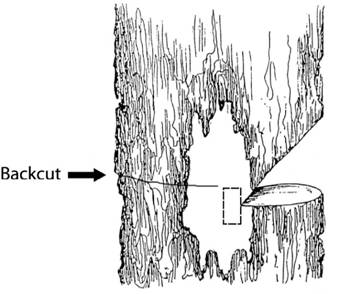
Backcut. The last of the three cuts required to fall a tree. Located
on the opposite side of the tree from the undercut (face) and minimally
two inches (5 cm) above the horizontal cut of the undercut (face). The
two inches (5 cm) is referred to as stump shot and prevents the tree from
kicking back over the stump toward the faller. The backcut must never
be continued to a point at which no holding wood remains. Variations of
backcutting are discussed in side-boring backcut and side-notching backcut.
Banking. A method of disposing of cut material against the opposite
(cold) side of the fireline.
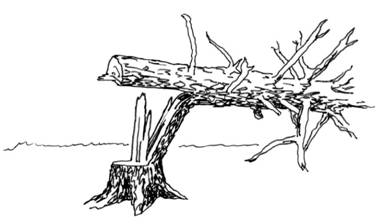
Barber-chair. Vertical split of a tree during the felling procedure.
Commonly a result of improper facing and/or backcutting. Characterized
by a portion of the fallen tree being left on the stump.
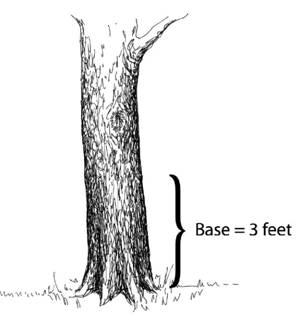
Base of Tree. That portion of a natural tree not more
than three feet off the ground.
Bed. Prepared area upon which a tree is felled.
BIA. Bureau of Indian Affairs.
Bind. Series of pressures in the material to be cut. The two major
components of bind are compression and tension. It is their directional
pressures that determine the technique and procedure used while operating
a chain saw.
BLM. Bureau of Land Management.
Blowdown. An area of previously standing timber blown over by
strong winds or storms.
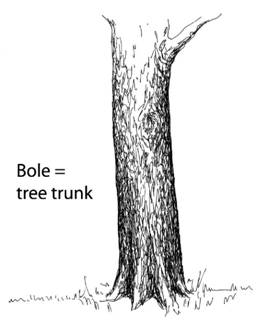
Bole. A tree stem once it has grown to substantial thickness capable
of yielding saw timber or large poles.
Boring. Method of using the bottom half of the guide bar tip to
saw into the tree while felling or bucking.
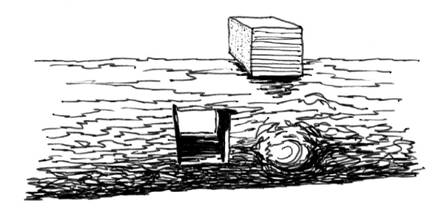
Bottom Bind. One of the five basic tree positions commonly encountered
while bucking. A tree in a bottom bind situation is tensioned on top and
compressed on the bottom.
Bow Bar. An elliptical saw chain guide bar used for brush cutting.
Its use is not suitable for falling or bucking wood over eight inches
in diameter. No longer approved by manufacturers for use on current saws.

Brushing. Removing the brush and shrubs either during fireline
construction or while clearing out a work area.
Buck. To saw trees and limbs into shorter lengths.
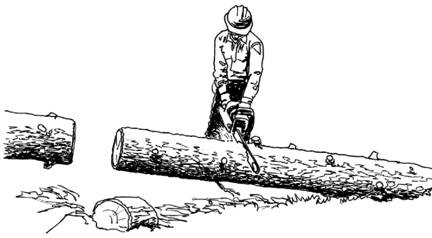
Butt. The bottom end of a felled tree.
<<< continue
reading—Wildland Fire Chain Saw Glossary, calks >>>
|