- March 19-22, 2026
- April 9-12, 2026
- April 23-26, 2026
- May 14-17, 2026
- June 4-7, 2026
- June 25-28, 2026
- July 16-19, 2026
- August 13-16, 2026
- September 10-13, 2026
- October 1-4, 2026
- October 22-25, 2026
- November 5-8, 2026
Cost: $800 includes tuition, books, meals & lodging.
Freeman Reservoir tree felling fatality, 72-hour report & OSHA citation — June, 2009
Andrew Palmer Fatality, Dutch Creek Incident, — June, 2008
OSHA citations
|
Wildland Fire Chain Saw Glossary
Pre-course Work
FEBRUARY, 2004
NFES 2644
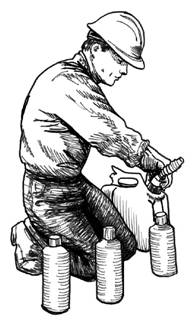
Grounding. Contact between a container and the ground point, usually
by wire, to prevent generation of static electrical sparks. Fuel containers
and chain saws must always be filled on the ground, not in a vehicle,
to establish an adequate ground. Fueling of chain saws must also be done
on the ground (not on a vehicle's tailgate), to ensure a positive ground
is established.
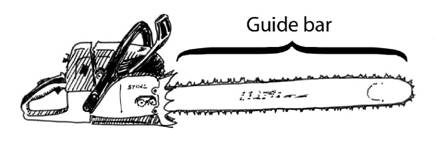
Guide Bar. Long, thin projection of the chain saw upon which the
saw chain travels. Improper use of the bar results in kickbacks and saw
cuts. It is the extreme top and bottom of the bar's tip that is sensitive.
Gunning (or Sighting). Technique of aligning the handle bars and/or
gunning mark with the desired felling direction. Since the handle bars
and/or gunning mark are at a 90° angle to the bar, exact position
of the undercut (face), in relation to the desired felling location can
easily be established. Not all saw handle bars are designed to be used
for gunning. Check your saw.
Hands-on Training. Supervised training that demonstrates the application
of knowledge and skill in a practical field exercise of proficiency.
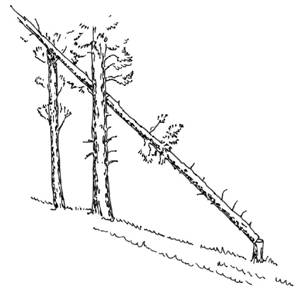
Hang-up. A situation in which a tree lodges in another and is
prevented from falling to the ground.
Hazard Tree. A standing tree that presents a hazard to people
due to conditions such as, but not limited to, deterioration or physical
damage to the root system, trunk, stem, or limbs, and/or the direction
and lean of the tree.
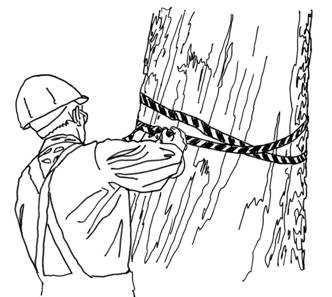
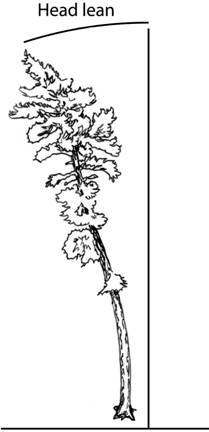
Head Lean. One of the two natural leaning forces found in most
trees. Head lean is the most prominent outward slant or lean of a tree
in reference to its base.
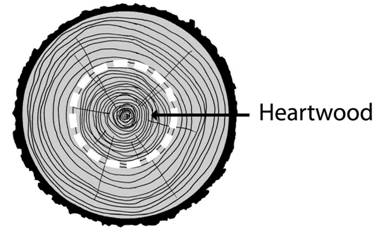
Heartwood. The inner layers of wood which, in the growing tree,
have ceased to contain living cells.
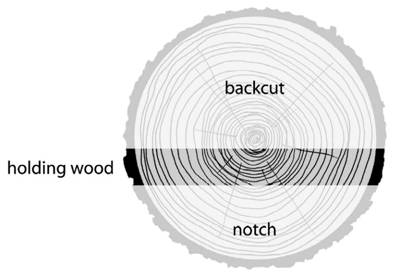
Hinge Wood/ Holding Wood. Section of wood located between the
undercut (face, or notch) and the backcut. Its purpose is to prevent the
tree from prematurely slipping from the stump until it has been committed
to the undercut (face). It maintains the tree's alignment with the direction
of fall. The holding wood must never be completely sawn off.
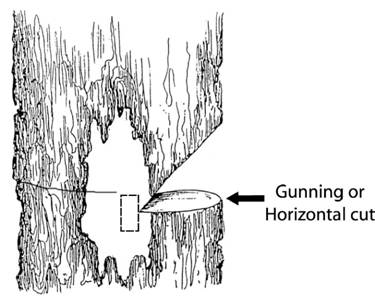
Horizontal (Gunning) Undercut (face) Cut. First of the two cuts
required to undercut (face) a tree. Its depth is minimally 1/3 the diameter
of the tree and level.
Humboldt Undercut (face). One of the types of undercuts (face
cuts) commonly used to fall a tree. The 45° sloping cut (face)
section is removed from the stump of the tree.
<<< continue
reading—Wildland Fire Chain Saw Glossary, indirect attack >>>
|